The Challenge of Creating Something That Doesn't Exist Yet with Artificial Intelligence
AI is extraordinary with what it already knows. The problem shows up when we try to step outside all of that.
English translation of an article originally written in Spanish. Leer el original en español.
In this article
There is something particularly hard to do with artificial intelligence: think of something new.
I am not talking about building an application, writing code, designing an architecture, or solving a known technical problem. For all of that, AI can be extraordinarily good. It has knowledge, patterns, documented experience, and an ability to relate concepts that turns out to be tremendously useful.
The problem shows up when we try to step outside all of that.
When we want to build something for which there is still no known solution. When we explore a problem that has no clear definition, when we want to take an idea to a scale that has never been tested, or when we try to find a path nobody has documented.
That is when the conversation changes.
AI always tries to take you to what it knows
By their very nature, artificial intelligence models work from learned patterns and relationships. When we present them with a problem, they try to find connections with what they already know.
They propose established architectures, existing frameworks, design patterns, well-known methodologies, and solutions that worked in other contexts.
And many times, they work.
But what happens when none of those solutions is enough?
We can spend hours talking, refining prompts, changing the approach, and asking for new alternatives. The AI will return increasingly elaborate proposals, but that does not necessarily mean we are any closer to finding a solution.
Let's be honest: it is not giving us the solution. It is giving us clues.
The value is in what it makes us think
And this is where something I find much more interesting comes in.
Even if it does not have the solution, AI can be an extraordinary tool for finding it.
It lets us explore paths we may not have considered, connect disciplines, question decisions, identify contradictions, and test our own hypotheses.
Even a wrong answer can be enormously valuable if it forces us to look at the problem from another perspective.
The key is understanding that we are not delegating discovery. We are using a tool that expands our capacity to explore.
There is an important difference between asking an AI to solve a problem and using it to discover how to solve it.
Asking it to solve the problem
- We expect a final answer
- It returns what it already knows
- We refine prompts without getting closer
- We delegate judgment
Using it to discover how to solve it
- We explore paths we had not considered
- We connect disciplines
- We spot contradictions and test hypotheses
- Judgment stays with us
When existing knowledge is no longer enough
In software development we are used to working on top of accumulated knowledge.
We have documentation, patterns, standards, frameworks, reference architectures, and thousands of implementations available to consult.
Artificial intelligence takes that ability to access and combine knowledge to another level.
But creating something new means facing situations where that knowledge is no longer enough.
We do not always have a precise definition of the problem. We do not know what the expected result is. We have no reference implementation and, many times, we do not even know whether we are asking the right questions.
In those scenarios, the process changes.
Walk through, step by step, the process a problem with no known solution demands.
- Form hypotheses about a problem that still has no clear definition.
- Experiment and build proofs of concept.
- Analyze results and recognize when a convincing answer does not actually solve the problem.
- Discard paths that lead nowhere.
- Start over, with a better understanding of the problem.
You have to form hypotheses, experiment, build proofs of concept, analyze results, discard paths, and start over.
And, above all, you need the judgment to recognize when a seemingly convincing answer does not really solve the problem.
The developer as explorer
I think this is one of the most interesting changes we are going through as software professionals.
As code generation becomes automated, our ability to produce implementations stops being the only differentiator.
The value lies more and more in understanding problems, identifying opportunities, designing experiments, evaluating alternatives, and making decisions when there is no obvious answer.
AI can enormously accelerate each of those activities. It can help us explore more possibilities in less time and lower the cost of experimenting.
But accelerating exploration is not the same as discovering.
And it certainly does not mean we can delegate the judgment needed to decide which path to follow.
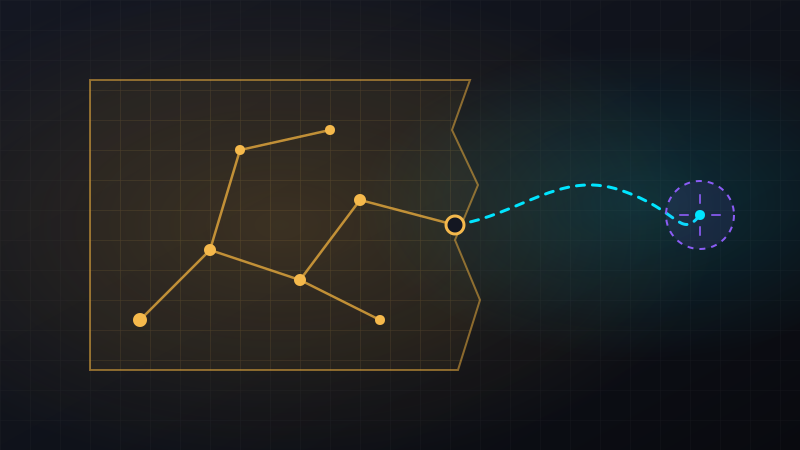
The map ends at some point
I do not think we should underestimate what artificial intelligence can do. Quite the opposite. It is one of the most powerful tools we have brought into our work.
But we should not confuse its ability to reproduce, combine, and transform existing knowledge with the ability to find answers to problems that still have no known solution.
AI can take us much further than we could ever get working alone.
But when the map ends, we still need someone willing to keep exploring.
And perhaps that is one of the biggest challenges (and opportunities) for those of us who build software in this new era.